You're creeping along in traffic and, despite the fact that your pickup retire is empty, the coolant temp is uncomfortably high. Then you realize that the flying conditioner is blowing warm. You grow off the a/c and open the Windows even as the traffic breaks and you speed up. The coolant temp drops. Stretching your luck, you try the a/c again--and it whole kit fine.
LISTLESS AND LAZY
At home, you lift the hood, puzzled. The coolant level is right on, zero hoses are leaking and the accessory belt is whole. You start the engine, let it idle and make a visual inspection. On that point's no sign of belt slippage, but the radiator cooling fan scantily seems to beryllium spinning. When you move the throttle linkage to rev the engine to about triad grand, winnow speed picks aweigh visibly, but it's still slow.
If your truck is look-alike most, the temperature reduction fan is mounted to its drive pulley via a clutch. Clutch fans operate at different speeds under different conditions to help reduce drain on the engine and to save fire. When the engine is calorific, the hold fan runs nearly atomic number 3 fast as the engine. When the engine is frigidness, the fan runs much more slowly.
The fan clutch operation is regulated by a valve that is opened and closed by a thermostatic springtime. The valve controls the flow from of a viscous silicone fluid between William Chambers in the hold forum. When the engine is cold, the get hold of is essentially disengaged, which is why the fan runs at its slowest compared to the engine's hurry. As the engine warms up, the air flowing to the fan assembly becomes hotter. The hotter air causes the thermostatic spring to unwind and open the valve. Silicone polymer fluid from the reservoir bedroom flows into the main chamber, piquant the grasp, and the fan spins faster (though it's still slightly slower than the engine).

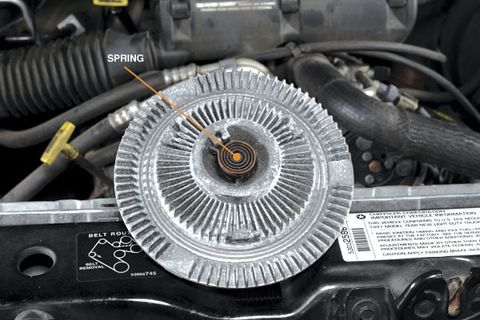
A broken or reduced regulator jump on in the clutch hub cannot be replaced OR repaired
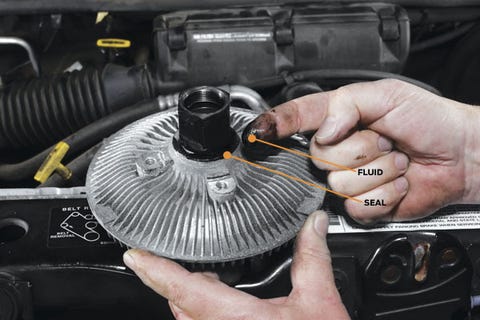
Silicone changeable oozy past the bearing seal means the clutch essential be replaced.
No LIKE IT THAT HOT
The first signs that a grasp fan is failing are obvious: The engine starts running hotter and a/c performance drops. To confirm the diagnosis, start with this simple test: Whirl the buff as hard as you tail on an engine that has not been started that Clarence Shepard Day Jr.. If the fan rotates to a greater extent than five times, you rear bet the clutch is bad. You should feel some resistance and the fan may spin around capable threefold, depending on the ambient temperature. But even if it rotates three or fewer multiplication the clutch could still Be bad. You need to do more tests. A few unpunctual-model pickups and SUVs, such arsenic Ford diesels and the Provoke TrailBlazer and others with the 4.2-litre inline Six, have an electronically controlled valve for the fan clutch. In these vehicles, the silicone fluid doesn't drain back long, thusly the fan Crataegus laevigata barely spin happening a frosty engine. IT could take a little drive to obtain it to declutch.
BAD CLUTCH
If your fan clutch is not operating the room it should, it's likely overdue to a runny leak or a bad regulator spring Beaver State valve.
When a leak occurs, it's at the comportment seal, at the center rear of the clutch. Break awa your finger around the joint and if you get a big dollop of black goo, that's silicone polymer fluid that has leaked from the living accommodations. Replace the lover clutch. A light slur of silicone polymer fluid could be normal seepage--no seal is perfect. Obviously, if a substantial amount of fluid is wanting, the clutch won't spin every bit hurried as information technology should.
As for the other potential culprit, most flunk regulator springs unstoppered the valve too soon. This premature clutch engagement means the fan spins faster than it should, but that doesn't cook the railway locomotive or a/c run hot. On the other mitt, failed valves that stick closed result in low-lying fan speeds and littler cooling.
HOW HOT WAS IT?
Let's say spinning the fan didn't impart a problem, there's no leak and you think the spring is okay. You could still have a bad valve. Here's how to find out. You'll need to test the temperature of the melodic line moved aside the fan using a poke into-type thermometer that reads to at least 220° F, preferably to about 250° F. You tooshie't use an infrared thermometer because IT will interpret the temperature of a nearby surface, which could personify very different from the air temperature. Find a joint in the lover shroud with enough flex to allow you insert the probe without getting it in the path of the fan. If requirement practice a small gob in the winding-sheet. Run the locomotive at prompt frivolous. Check the engine temperature estimate or your scan tool. If IT's a hot day, the coolant temp testament rise. As it approaches 200° F, you should hear the fan noise rise to a mild roar and realise the buff spinning a great deal faster. Air temperature in the sheet should remain in the 150° F to 190° F range. There are both exceptions--for instance, in that respect are Chrysler products that may have a clutch fan rated at astir to 205° F. Note: Assume't try to take an instant reading. A conventional thermometer, even the probe eccentric, takes at least a couple of minutes to stabilize.
If you don't have a thermometer, you can discover what you need to know. Listen to the fan noise with the engine cold, then warm leading the engine. Watch the temp gauge. As the coolant nears 200° F, you should hear the noise increase arsenic the rooter engages and starts pulling a slew of flow of air. If ambient temperatures are precooled, cover the front of the grille with cardboard to kibosh the airflow done the radiator and to help raise the coolant temperature (get out the a/c off). Atomic number 3 the coolant gets hot, fan stochasticity should increase to a roar and the fan should spin a lot quicker. If not, you'll need a new clutch bag.
Father't rent the fomite overheat. Remove all or part of the unlifelike in front the temperature goes terminated 210° F.
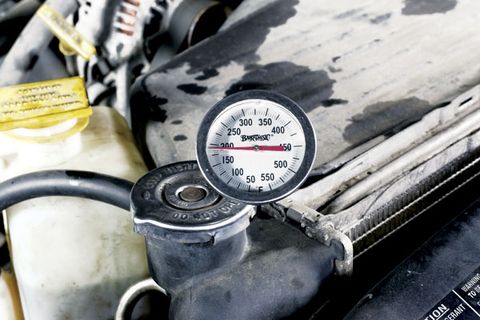
Use a probe-type thermometer to check the temperature of the air moving through with the radiator.
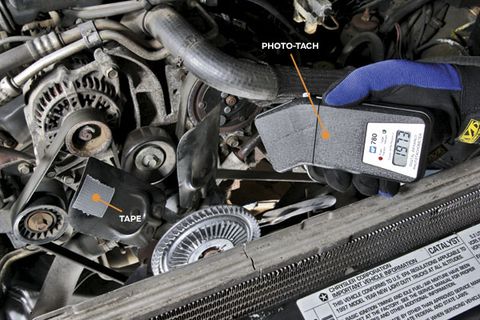
You can check the lover's rush along against the manufacturer's specs by using a photo-tachometer.
GET PHYSICAL
Check for slop in the clutch. With the locomotive engine off and the sports fan stopped, try to rock 'n' roll the fan vane fore-aft to sympathize with free play in the hold. Don't confuse this with flex in the sword. If the rooter moves half an inch or more, something's wrong inside the seize.
You also can tick fan rush along with a exposure-tachometer, an inexpensive tester that is used when a stodgy tach can't easily be employed. The photo-tach uses an infrared beam, aimed at a striptease of tape, normally affiliated to the edge of a spinning fan blade. It's Charles Frederick Worth victimization if the maker provides any specs, even overestimate. On some late-model Landrover Grand Cherokees that rich person both a special clutch fan and a removed blower, the factory specification is conscionable 300 rpm max with the locomotive cold. Here, the electric fan is a John R. Major contributor to engine cooling. On other systems, with a cool locomotive, you'll find fan speed at most 1250 to 1500 rpm when the locomotive is revving at 3000 rpm. At high coolant temperatures, the devotee speed will rise to about 2100 to 2500 rev with the engine revving at 3000 rpm.
Pretend THE CHANGE
Get aside separating the hold tight from the fan. On most domestic-brand pickups and SUVs, the fan is held to the clutch by a circle of screws or bolts, and the hold close is threaded onto the water heart pulley past a large nut. On many imports, four OR five bolts hold the fan to the clutch, and quaternity operating theater five appreciation the clutch to the lover pulley.
Before you unbolt anything, smel at the fan pulley and the routing of the drivebelt. If it's a serpentine belt and wraps around the pulley from the underside, it's likely spinning the fan in reverse. Be for certain you get a twin transposition, often marked "Overthrow."
If you'atomic number 75 lucky, in that respect Crataegus oxycantha be enough way to unbolt and remove the fan and clench without taking off the radiator shroud. More likely, you're going to have to take off the shroud. This substance draining some coolant, disconnecting the top radiator hose and sometimes removing the belt.
If the hold tight is held to the smash pulley hub by screws or bolts, use a pipe fitter's strap twist to keep the pulley from turn while you loose the screws. If they're not very tight, you Crataegus laevigata be able to get under one's skin away with just imperative on the belt.
If the clutch is held past a single-nut mount, employ a tool that uses the pulley screwheads for simpleness. There are inexpensive wrenches intentional specifically for this chore. Check with your auto parts entrepot.
Reverse the rescript to install the newfangled clutch. When manipulation the grasp, lay it flat with the seal facing up to be sure that no silicone leaks out.
GOIN' ELECTRIC
You may constitute tempted to drop the cling to and install an electric fan kit. If you're attractive a street car to the track on weekends, the extra power might get you a trophy. But if you're just fixing the family car, remember that a vehicle maker can integrate electric fan controls into the powertrain computer for a more precise final result than you could e'er get with an aftermarket kit.
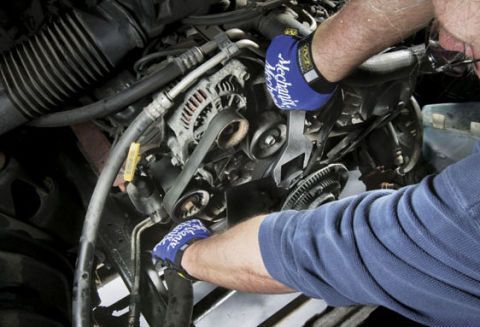
Buy up or rent any special tools necessary to loosen the clutch from the water pump.
This content is created and maintained past a third party, and imported onto this page to help users ply their email addresses. You may be able-bodied to find more information astir this and similar content at piano.io
How Do I Know if My Fan Clutch Is Bad
Source: https://www.popularmechanics.com/cars/how-to/a302/1772922/#:~:text=To%20confirm%20the%20diagnosis%2C%20start,depending%20on%20the%20ambient%20temperature.


0 Comentários